By the middle of November, the offers have already started. Banners, countdowns and last-chance emails all say the same thing: be quick. Green Friday asks something different. It asks what a thing is made of, how long it will last and where it goes when you are done with it.
Here is where the idea came from, how it differs from Black Friday and what it can mean for something as long-lived as a bed.
What Is Green Friday?
Green Friday is a counter-movement to Black Friday. Instead of treating a discount as a reason to buy, it asks whether the purchase is needed at all, and what the thing is made of, how long it will last and where it goes afterwards. Brands run it very differently, so the name alone tells you little.
It began in France in 2017, as a counterweight to Black Friday's overconsumption. La Libre reported that 560 organisations across France and Belgium took part that first year.
Its meaning has shifted since then. Some brands use the name to encourage more considered buying. Others use it for repair, reuse or donation. Some use it as a discount with a leaf on it. Which is why it helps to have a way of telling the difference.
What Green Friday Means at Heveya®

A bed is the one thing not to rush. You sleep on it every night for years, and it is not a small thing to get rid of afterwards. Yet November is sold on speed and price, which is close to the opposite of how anyone should choose one.
Choosing well, without choosing more.
It was not written for November. It is simply how we have built things from the start: one kind of bed, made from materials we can name, in a way we are willing to explain. What we are really selling is peace of mind, and nobody gets that from a mattress they know nothing about.
We would rather make something that outlasts us than something that sells in a weekend.
One thing should be said plainly before any of the rest. Buying a mattress does not help the planet. The most sustainable mattress is the one you already own and are still happy with. If that is you, keep it. This article is not here to sell you a bed you do not need.
Read Also: Heveya®'s Commitment to a Sustainable Future
The Choices We Already Make
None of what follows is new for November. These are things we already do, and each one has a page you can read for yourself.
What it is made of

Heveya has been a Certified B Corporation since May 2024. We scored 87.4 on the B Impact Assessment. Eighty is the pass mark. The median for companies that sit the assessment is 50.9.
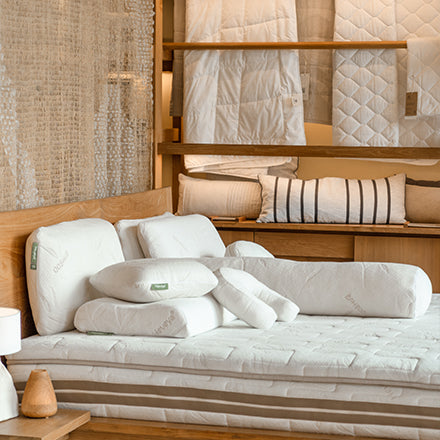
We'll talk about the bed itself. Natural latex at the core. Bamboo lyocell and organic cotton for the covers. Wool, latex or goose down for the toppers. A short list, and that is the point: the fewer things in a bed, the easier it is to say what is in it.
Then there is how the products are made. Our bamboo lyocell is made in a closed loop, so the solvent is recovered and used again rather than discharged. Our supplier recycles its wastewater. We use green electricity at our workplace. No pesticides, no heavy metals, no VOCs, no glues.
How long it is built to last

Natural latex tends to outlast the mattress built around it. It is common for the cover, the base or the stitching to give out while the latex inside is still sound.
That shapes how ours are put together. The layers are separate rather than bonded into a single block, so a firmness can be changed or a single part replaced without replacing the whole bed. The covers come off and can be dry cleaned. A mattress that can be repaired is a mattress that does not need replacing.
What happens afterwards
We should be straight about the limit. A latex mattress at the end of its life is still a hard problem, and there is no complete answer yet for every bed we have sold. Here is what exists today.
Our take-back programme collects preloved Heveya mattresses with free pickup, and the latex is reused in rebonded products. It covers Heveya mattresses only.
What we do beyond the bed

Some of what we do sits outside the bed entirely, and it is worth being clear that it offsets nothing.
We pledge to plant 12,000 trees every year in Borneo, with Replant.world and indigenous partners. Through the Wake-up to a Greener Planet Program, purchases come with tree tokens, up to 20 trees per purchase, and the tokens can be passed on so more are planted.
In Bali, we are an official sponsor of the Happy Mattress Project, alongside Karma House and Yogi Lab, working towards 333 Beds in 33 Days.
Heveya's Green Friday 2026

Heveya is preparing something special for Green Friday in Indonesia. Stay tuned from 6 November 2026.
If you are considering a new bed this month, bring the three questions with you. What is it made of. How long is it built to last. What happens to it afterwards. Ask us at the showroom, and ask whoever else you are considering.
Frequently Asked Questions
1. What is Green Friday?
Green Friday is an alternative to the Black Friday shopping rush that encourages people to consider whether a purchase is needed at all. It began in France in 2017. The actions behind the name vary a great deal between organisations.
2. What is the difference between Green Friday and Black Friday?
Black Friday is organised around price and discounts. Green Friday is organised around what something is made of, how long it will last and what happens to it afterwards. Both names cover very different activities in practice, so it is worth looking at what a brand actually does rather than at the name of its campaign.
3. When is Green Friday 2026?
Green Friday is generally marked around Black Friday, which falls on Friday 27 November 2026. Individual brands run it over different periods.
Source
1. La Libre. (2022, November 21). Pourquoi dit-on le "Black Friday"? Et pourquoi s'est-il importé chez nous? LaLibre.be.